 VENTEEVE
Picture a walkie-talkie. You press the button, say your piece, say "over," and wait. The other side does the same. It works. It also feels like a hostage negotiation conducted by two very polite robots.
That is roughly how most phone AI has worked until now. Then, on October 23, a small research lab inside Block (the company behind Square, led by Jack Dorsey) announced Dessa, a voice model that doesn't take turns at all. Reaction was swift. TechCrunch's headline said it sounds eerily human.
What Dessa Actually Is
Dessa is a full-duplex speech-to-speech model, currently a research preview. Audio goes in, audio comes out, and it listens and talks at the same time. According to Block, it was trained from scratch on human conversation audio only: no text, no pretrained models.
The demos are where it gets strange. Block says Dessa natively hears and produces emotion, sarcasm, laughter, sighs and voice cracks. In demos it laughs mid-sentence, speaks louder when asked, and, in one clip, says it's tired from work and sounds tired. It drops little "yeah" and "got it" cues while you talk, the way a person does to show they're listening. Block says it runs faster than real time and can run locally on a MacBook Pro with an M4 Max chip or better. Its lead, Ragavan Thurairatnam, called it "a GPT3 moment for speech."
Want to judge for yourself? You can hear the recorded demo calls on Block's Dessa page. Then keep a caveat in mind: those are Block's claims. No independent evaluation has been published, no latency figures have been shared, and the company hasn't named supported languages.
Three Ways to Build a Talking Machine
To see why Dessa matters, it helps to know how voice agents are built. There are three designs.
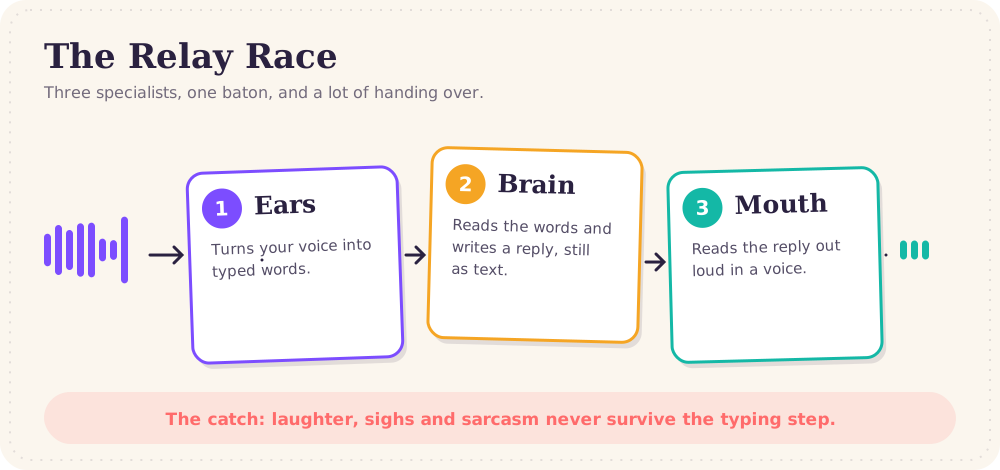
The cascade is the original. One model transcribes your speech into text, a language model reads that text and writes a reply, and a third model reads the reply aloud. It is flexible, because you can swap any part. But Block's argument is that turning speech into text throws information away: the sigh, the sarcasm, the hesitation.
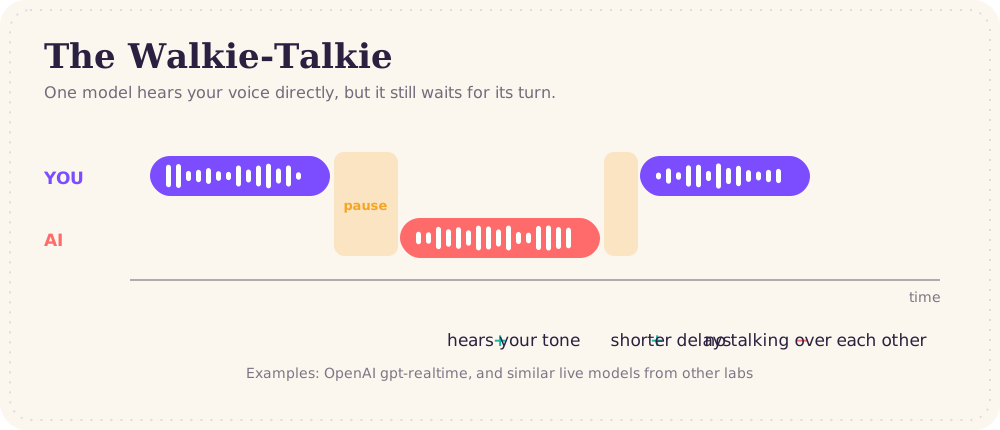
Turn-based speech-to-speech collapses the chain. OpenAI's gpt-realtime, launched in August 2025, processes and generates audio directly through a single model, which OpenAI says cuts latency and keeps the nuance. Microsoft's documentation likens this style to a walkie-talkie: one party transmits at a time.
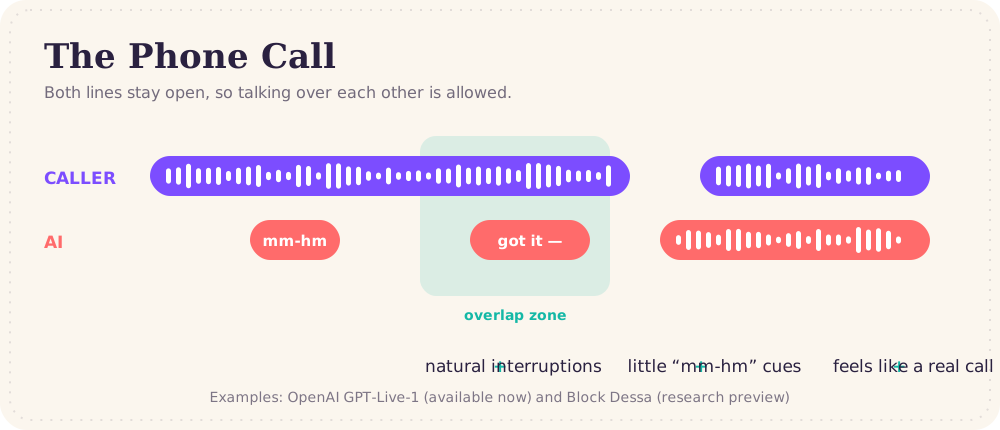
Full-duplex is the telephone call. Both directions run at once, so the agent can keep listening while it speaks, be interrupted, and murmur a backchannel. Dessa belongs to this third family.
What You Can Use Today
Dessa isn't something you can build on yet. Reporting indicates there's no API, pricing, model weights or release date, and access is limited to a small group of AI safety researchers, with a public waitlist.
Full-duplex, though, is already out there. OpenAI released GPT-Live-1 to its API on September 10. It supports phone connections (SIP) alongside WebRTC and WebSockets, is priced at $0.05 per minute for the voice session with backend model and tool usage billed separately, and OpenAI reports turn-taking latency of 0.798 seconds versus 1.41 seconds for its GPT-Realtime-2.1.
It isn't magic. In OpenAI's design the live voice model handles the conversation and hands reasoning and tool use to a backend, and developers on OpenAI's forum have reported rough edges, such as unreliable call endings. This is where Venteeve's work lives: we build our clients' voice agents on full-duplex models, and spend our time on those handoffs, so the call feels natural and the booking still lands in the calendar.
Where This Is Heading
Block's own comparison lists open full-duplex models already available, Kyutai's Moshi and NVIDIA's PersonaPlex-7B, both with downloadable weights. Add Dessa's claim that it can run on a laptop, and the direction is plain: more of these models, on cheaper hardware, in more hands. If Dessa ships close to how it's been shown, a voice that's hard to tell from a person's becomes a baseline expectation. I can't promise when, or whether it lands as described.
For a business owner, the takeaway is practical. Callers will soon expect to be heard without waiting their turn, and they'll hold your phone line to that standard. Start with a full-duplex agent that answers every call, books the job and tells callers it's an AI. As voices get more convincing, being upfront will matter more, not less. Block itself has asked safety researchers to probe how such voices could deceive people.