 VENTEEVE
Every few months a new voice model arrives with a table of numbers and a confident adjective. Grok Voice 3.0, released by xAI on October 14, is the latest. Here is what was actually published, what the numbers say, and what they do not.
The Basics
Grok Voice 3.0 is available in xAI's speech-to-speech API at $0.08 a minute, or $4.80 an hour. xAI says that is the same price as Grok Voice 2.0. It also says agents using its grok-voice-latest setting "have already been switched over automatically, with no changes needed."
On speed, xAI claims "class-leading latency at under one second" and says Grok Voice 3.0 runs at 40% lower latency than GPT-Live-1 (Astra) on one comparison. The announcement gives no millisecond figures, so treat the speed claim as a claim.
The Benchmark Table
xAI's headline evidence is a comparison built on figures from Artificial Analysis, dated October 13, 2026. The overall index combines speech reasoning, τ-Voice, and preference and task success from blind head-to-head calls.
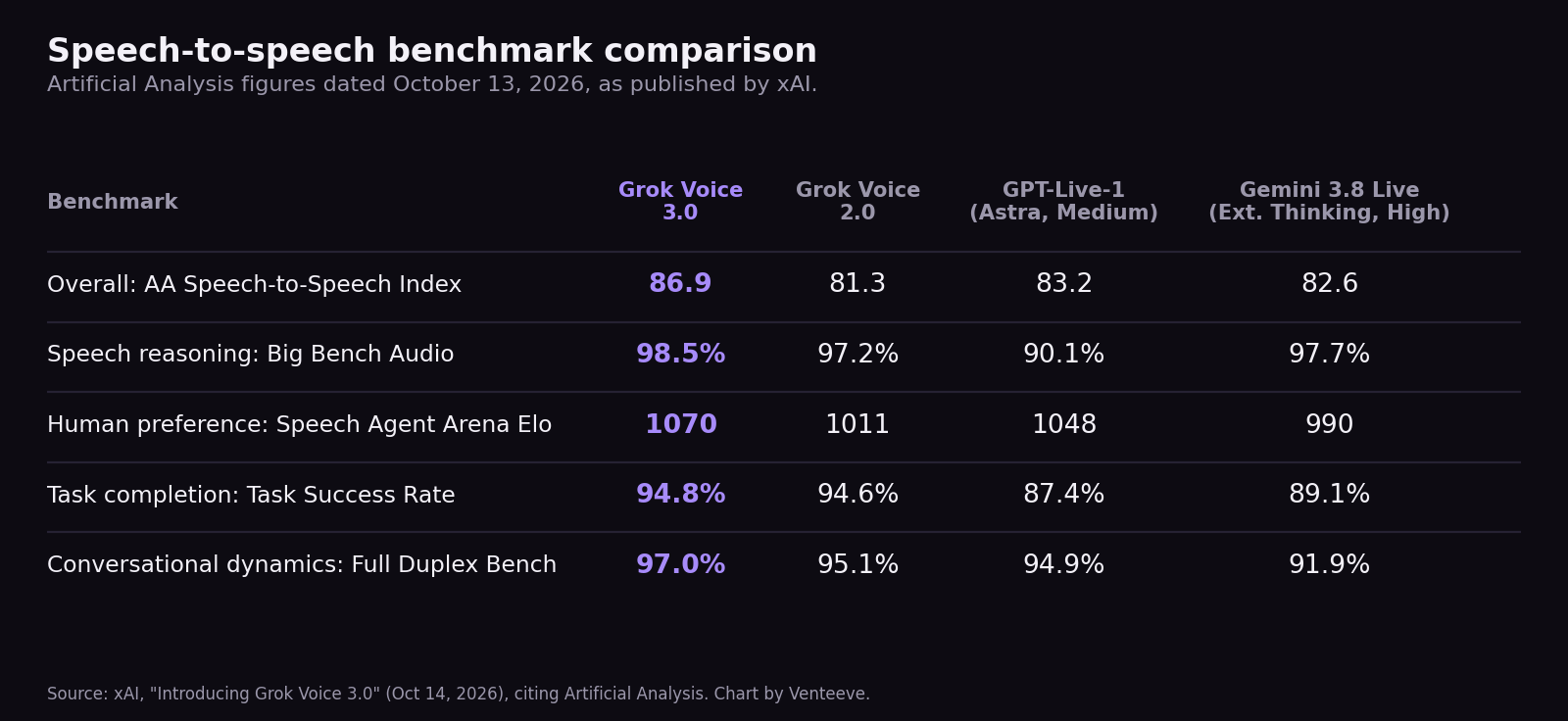
Grok Voice 3.0 tops every row: 86.9 on the overall index against 83.2 for GPT-Live-1 and 82.6 for Gemini 3.8 Live, and 97.0% on Full Duplex Bench, which xAI describes as measuring how a model handles pauses, turn-taking and interruptions.
One row is worth a second look. On Task Success Rate, Grok Voice 3.0 scores 94.8% and Grok Voice 2.0 scores 94.6%. The biggest gains over its predecessor are elsewhere, and on that row the older model was already close.
The One Test It Does Not Win
xAI also shows τ-Voice, an agentic benchmark, and this is where the picture gets more interesting. Grok Voice 3.0 scores 71.6%, up from 56.5% for Grok Voice 2.0. But GPT-Live-1 scores 74.5%, ahead of it. Gemini 3.8 Live scores 68.6%.
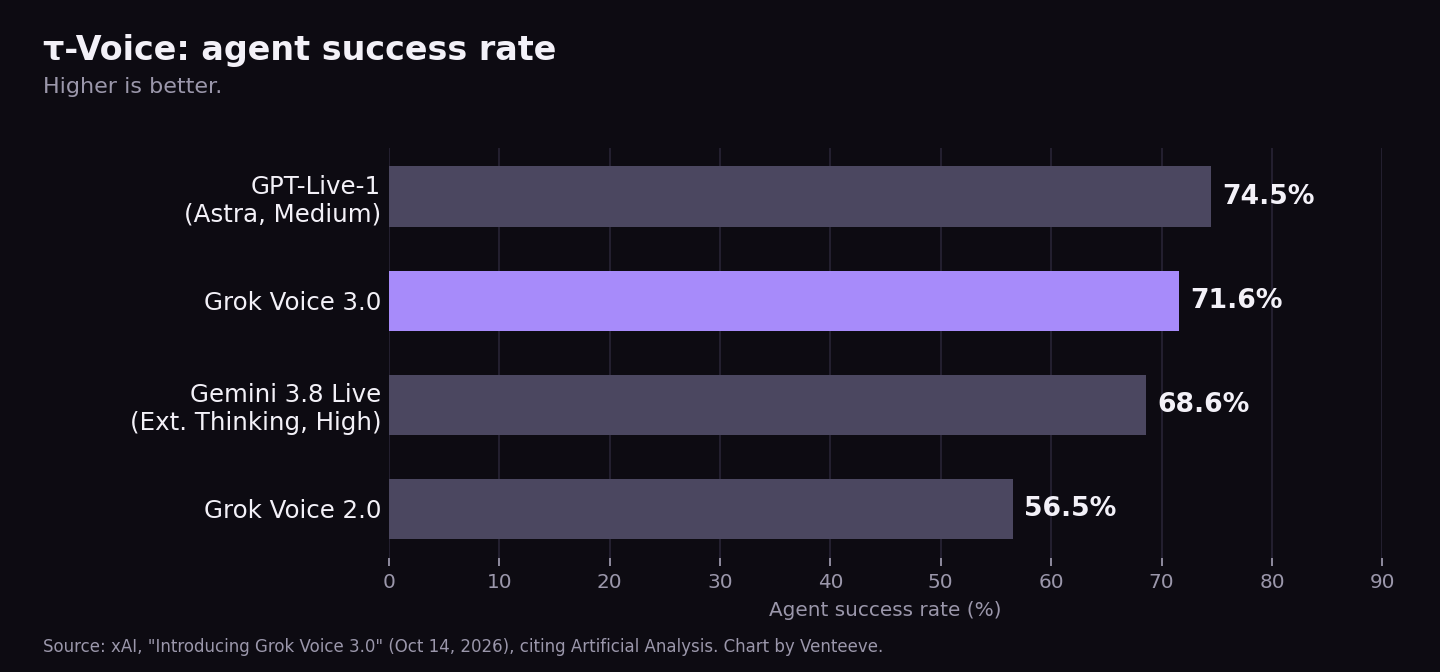
xAI calls Grok Voice 3.0 comparable with GPT-Live-1 here, at lower latency. That is a fair reading of a 2.9-point gap, and it is also to xAI's credit that the chart is on the page at all.
On ServiceNow's EVA-Bench, a benchmark for enterprise voice agents, xAI says Grok Voice 3.0 "achieves the highest accuracy score at 74%." Nitin Aggarwal of ServiceNow is quoted saying it "sets a new Pareto frontier on EVA-Bench."
Cost, and the Customer Claims
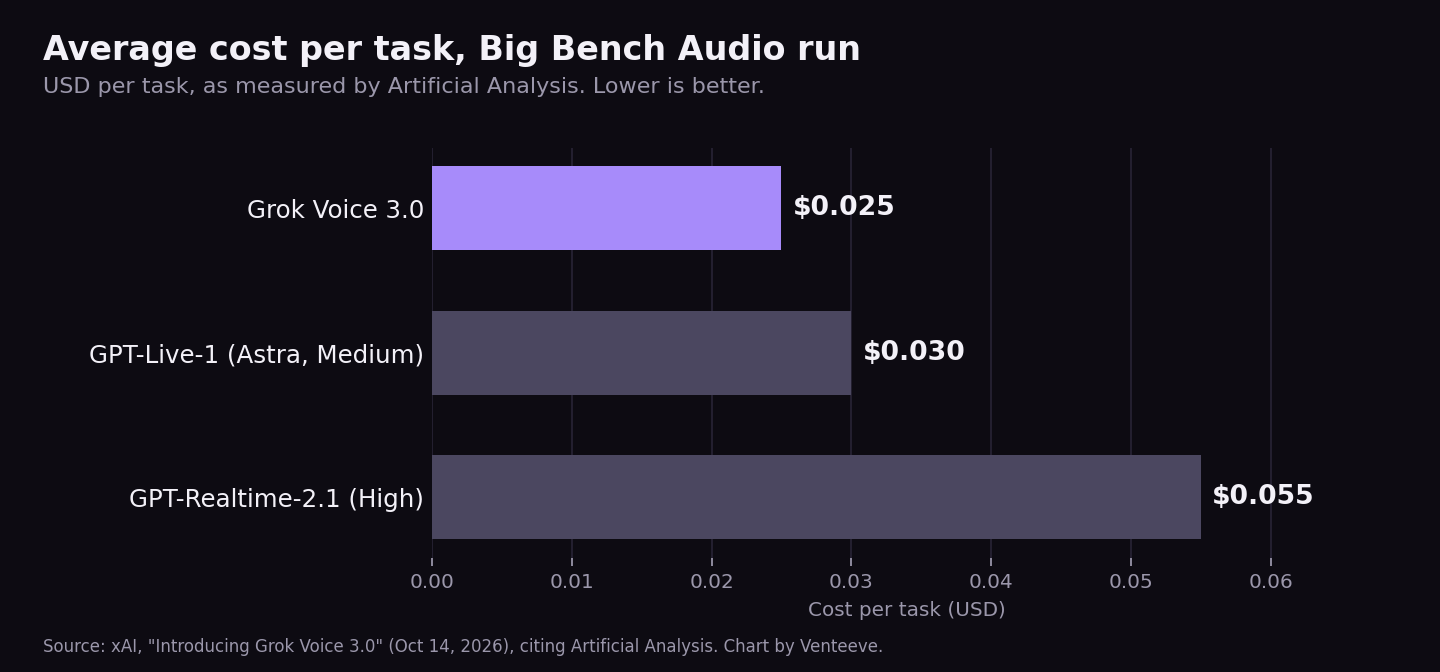
On Artificial Analysis's Big Bench Audio run, the average cost per task was $0.025 for Grok Voice 3.0, $0.030 for GPT-Live-1 and $0.055 for GPT-Realtime-2.1. These are per-task costs on one benchmark, not what your phone line would cost per call.
xAI also names customers. It says Grok Voice handles millions of conversations a day in Tesla vehicles, and that Starlink call centers use it to answer 20,000 customer calls every day across multiple languages, with about 70% resolved with no human in the loop and about one in four sales calls ending in a purchase before the caller hangs up. These are xAI's own figures about its own customers, and the announcement does not say how they were measured.
What This Means If You Run a Business
Three plain takeaways. First, xAI kept the price the same from Grok Voice 2.0 to 3.0, so the upgrade did not cost more per minute. Second, no single model wins everything: Grok Voice 3.0 leads most of this table and trails on τ-Voice, and leaderboards like this one are a snapshot.
Third, notice what happened to agents on the latest setting: they moved to the new model without anyone doing anything. That is convenient, and it also means the thing answering your phone can change without a decision on your side. Whoever runs your agent should be able to tell you which model it uses, and should replay some of your own calls before and after any switch.
Benchmarks tell you which model to shortlist. Your own call recordings tell you which one to keep.