 VENTEEVE
Somebody builds the agent on a Tuesday. It's genuinely a good afternoon's work. The voice is warm, it books appointments, it doesn't say anything embarrassing about the competition. Everyone stands around the laptop listening to a test call and someone says the word "wow" out loud, unironically, for the first time since 2011.
Then it goes live. And for about three weeks, nobody asks it anything.
Then, inevitably, somebody does. A client rings and says: so how's it going? And that is the moment the whole thing falls over — not the agent, which is fine, but you. Because you do not know. You have a hunch. You have a feeling it's going well. What you do not have is a sentence you'd be willing to put in an email.
The Question Nobody Can Answer
Try it right now with whatever you have running. How many calls did it take last month? What percentage ended with the caller's problem actually solved? How many turned into a booking? Which of your agents is quietly burning most of your credits? What are people ringing about that you didn't build an answer for?
If you're running agents on ElevenLabs, every one of those answers technically exists. It's just scattered across a platform built for the person who made the agent, not the person who has to justify it. So you export things. You paste them into a spreadsheet. You count rows on a Sunday evening like a Victorian clerk.
And if you're an agency running agents for other people, it's worse, because now you're doing that for six clients, and each of them wants a report, and none of them should ever see each other's calls.
So We Built the Missing Screen
The Venteeve Dashboard is the answer to "how's it going" — as a page you can open, not a spreadsheet you have to build. You connect it to ElevenLabs with an API key, and it reads everything your agents have already been doing. No migration. No rebuilding your agents somewhere else. No changing a single thing about how they run.
If you haven't set up your agents yet, that's the place to start — build them on ElevenLabs, then point the dashboard at them.
You land on the number you actually needed: total calls, total talk time, average duration, success rate, bookings made, active agents, average credits per call. Plan credits used and remaining, so nobody discovers the balance is empty by way of a customer complaint. Calls per day, coloured by outcome, so a bad week has a shape you can point at.
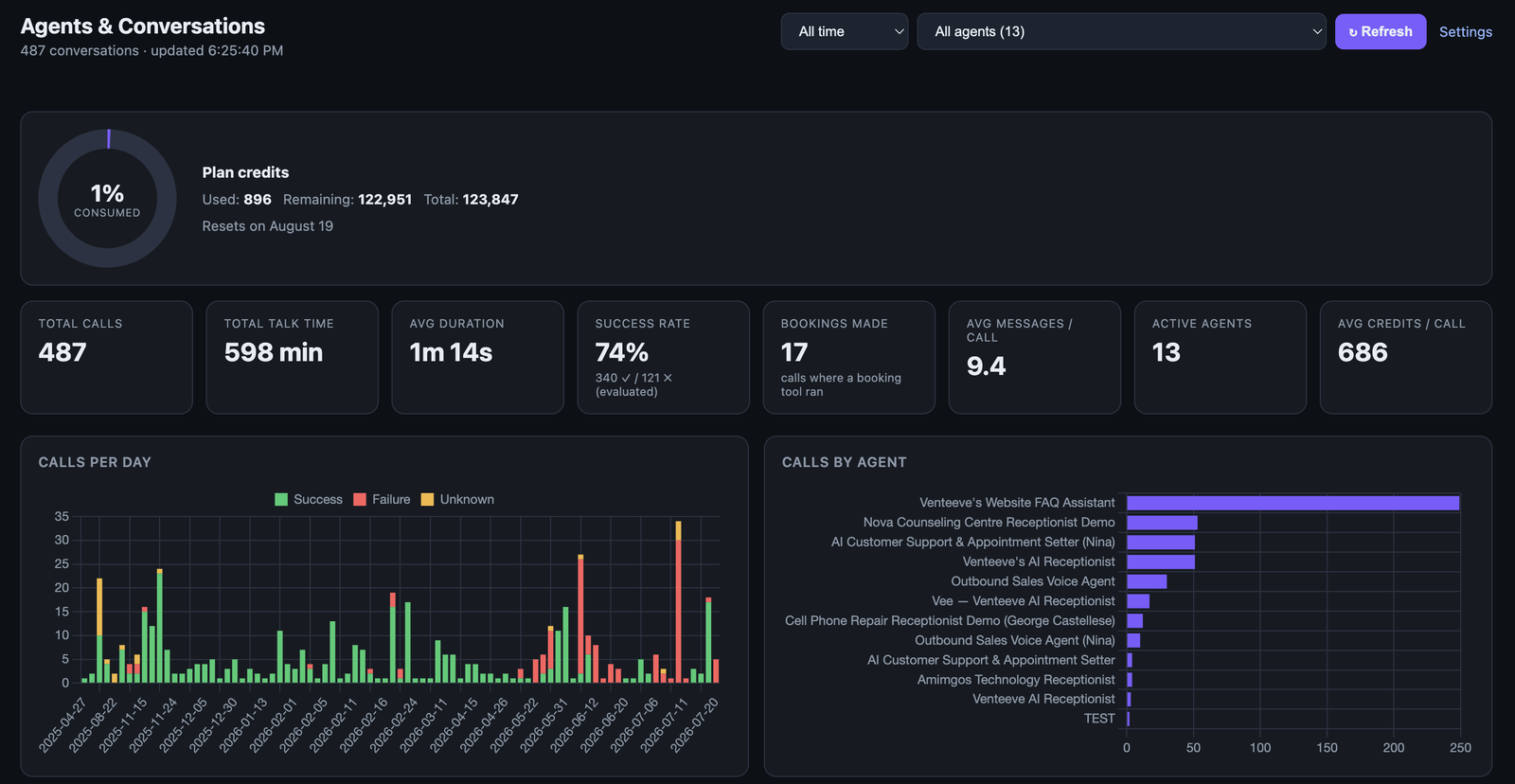
Underneath that, the part that turns a number into a decision. Call outcomes split success, failure and unknown. Credits spent by agent, so you can see exactly which one is expensive and whether it's earning it. And two panels most people have never had at all: how each of your evaluation criteria is actually performing, and how often your agents are managing to collect the data you asked them for.
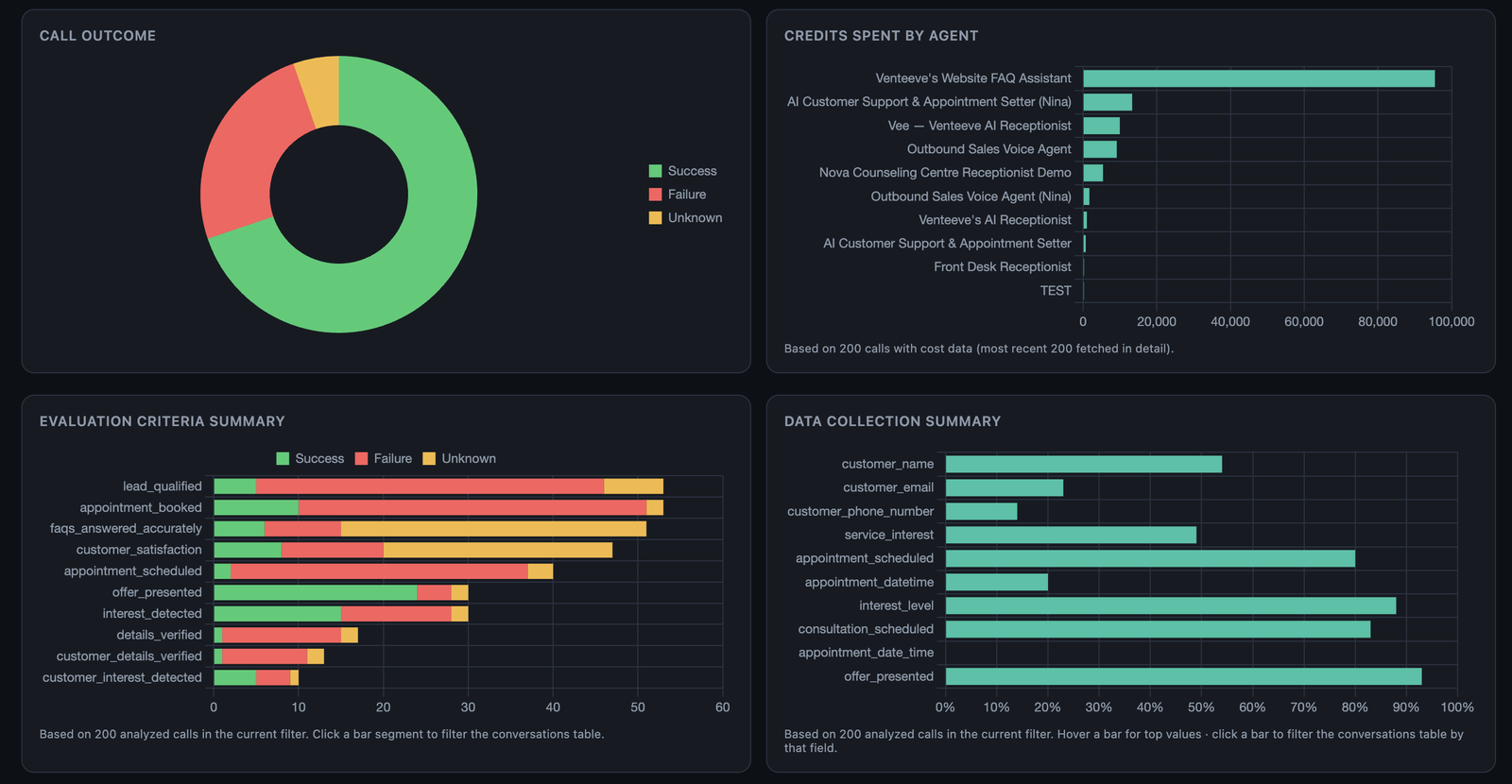
That evaluation panel is the one that changes behaviour. It is very easy to feel good about an agent that sounds lovely. It is considerably harder to feel good about a bar chart showing lead_qualified coming back red most of the time. That's not a criticism of the product. That's the product working.
Finding the One Call That Explains Everything
Numbers tell you something is wrong. They never tell you why. Why is always in a specific call, and the specific call is always the one you can't find.
So the dashboard borrows ElevenLabs' topic discovery and shows you what people are actually talking about, ranked. Not what you assumed they'd ring about — what they did ring about. Click a bar and you get those exact conversations.
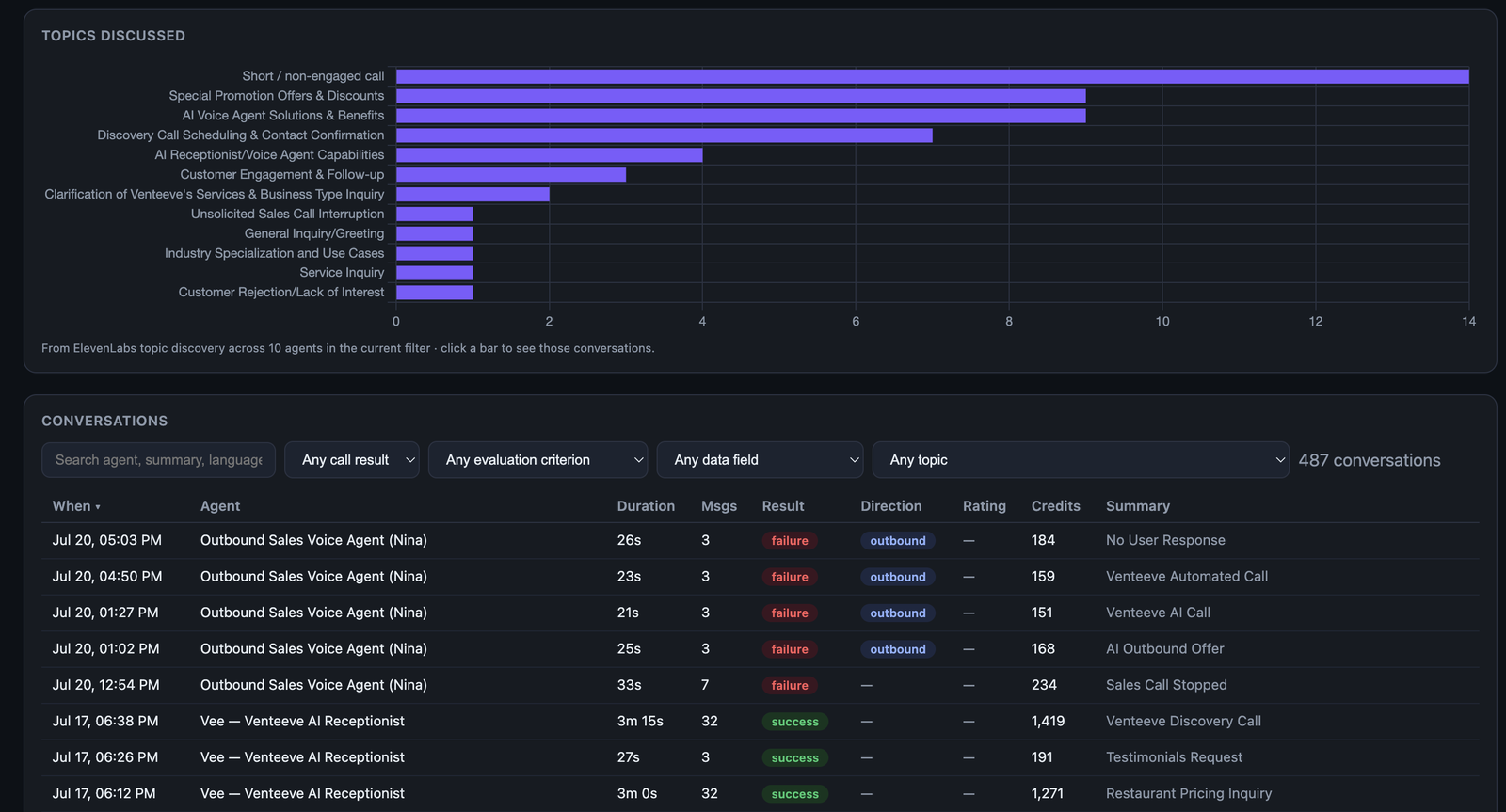
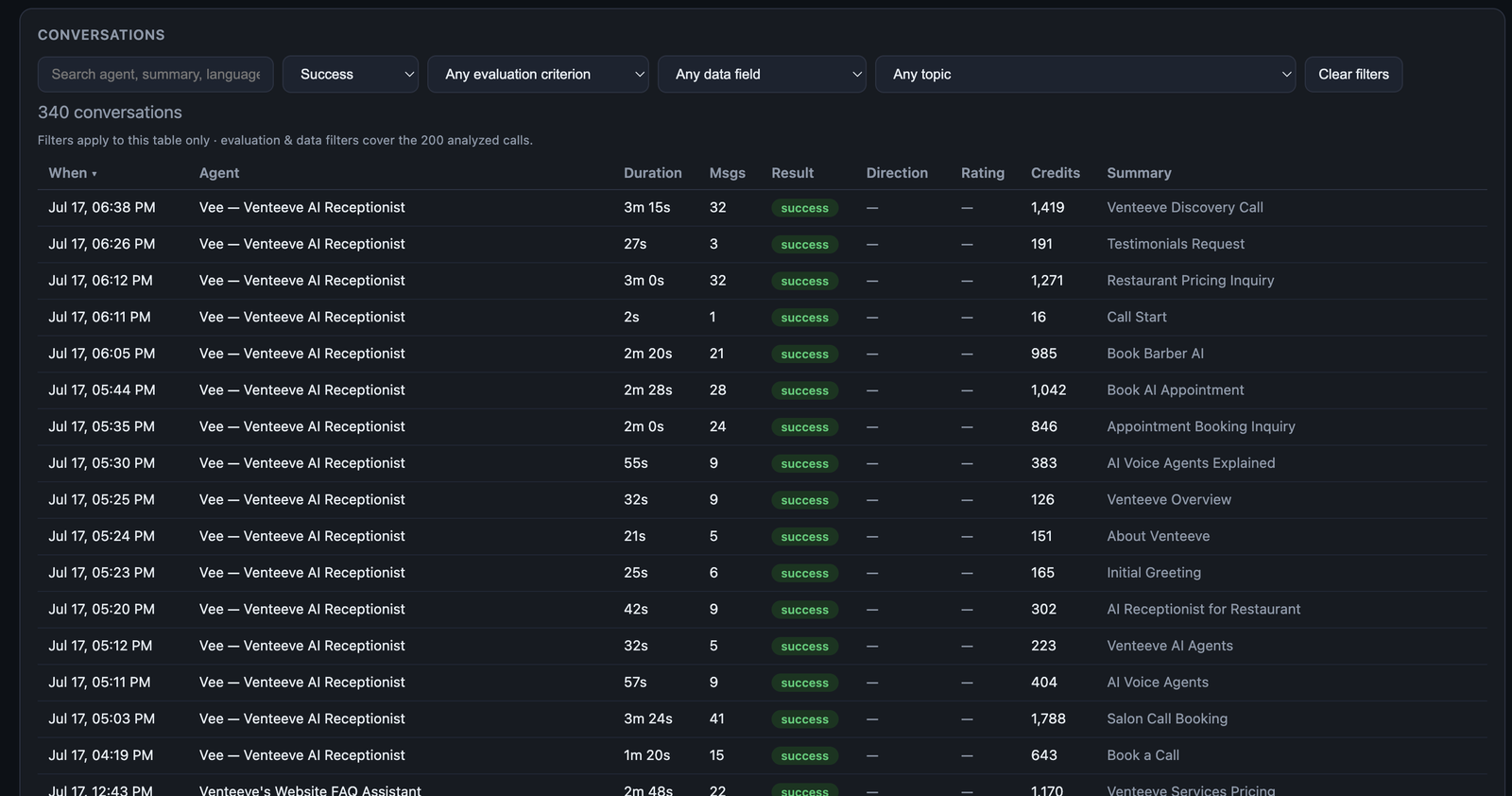
Then filter the conversation log by anything that matters: free-text search, call result, a specific evaluation criterion, a data field, a topic. Want every successful call? One dropdown. Want every call where the agent failed to book despite the customer showing interest? Also one dropdown.
And when you find the call, you open it in place. Summary, evaluation results, the data the agent collected, why the call ended, the audio, and the full transcript — the actual back and forth, line by line. There's a link straight through to ElevenLabs if you want to go and change something.
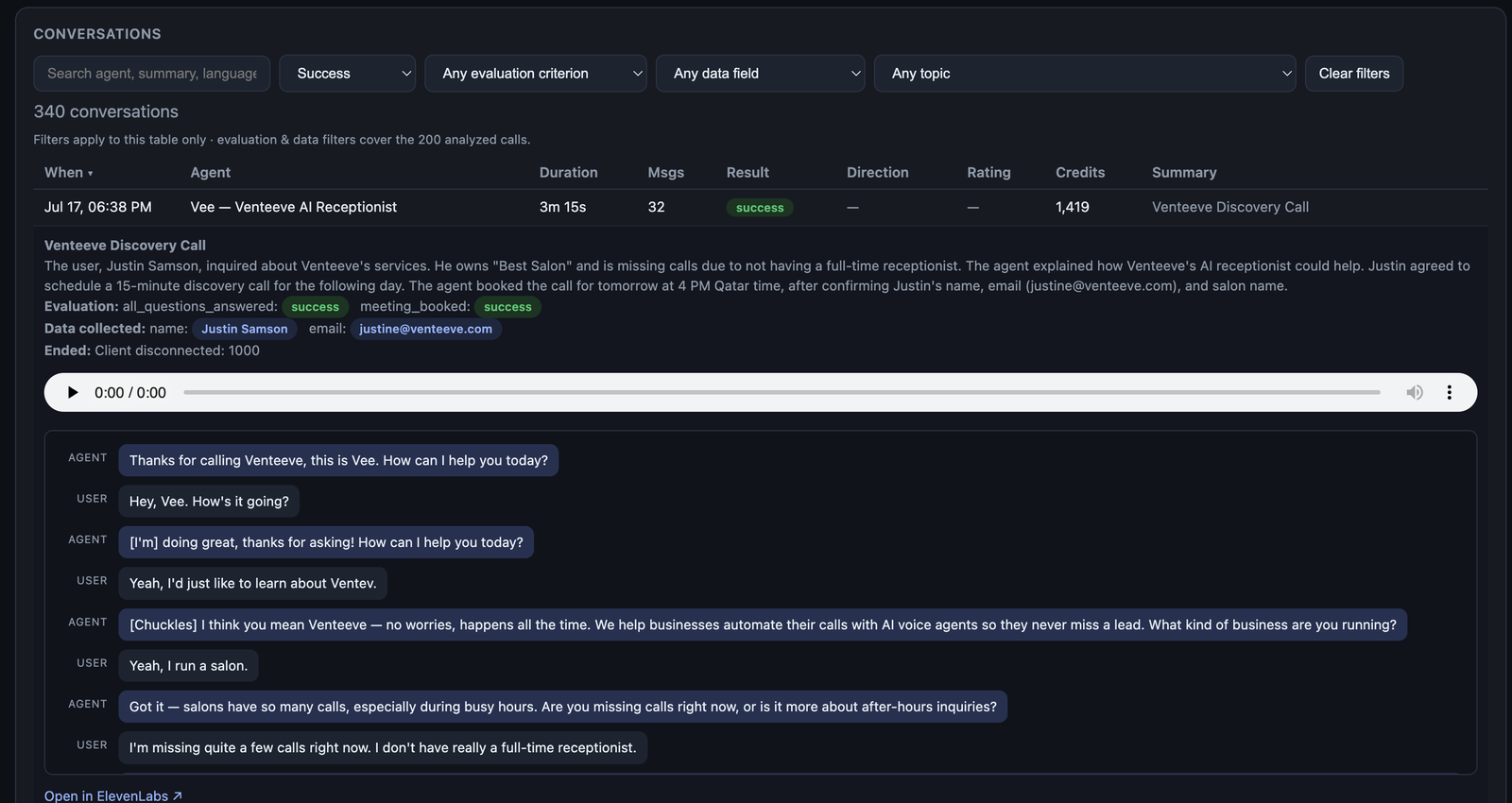
This is the part that quietly makes you better at this. Read ten real transcripts and you will find the same awkward sentence tripping people up every time. You cannot get that from a success rate.
It's White-Label, Which Is the Whole Business Model
Here's where it stops being a nice internal tool and starts being a way to charge money.
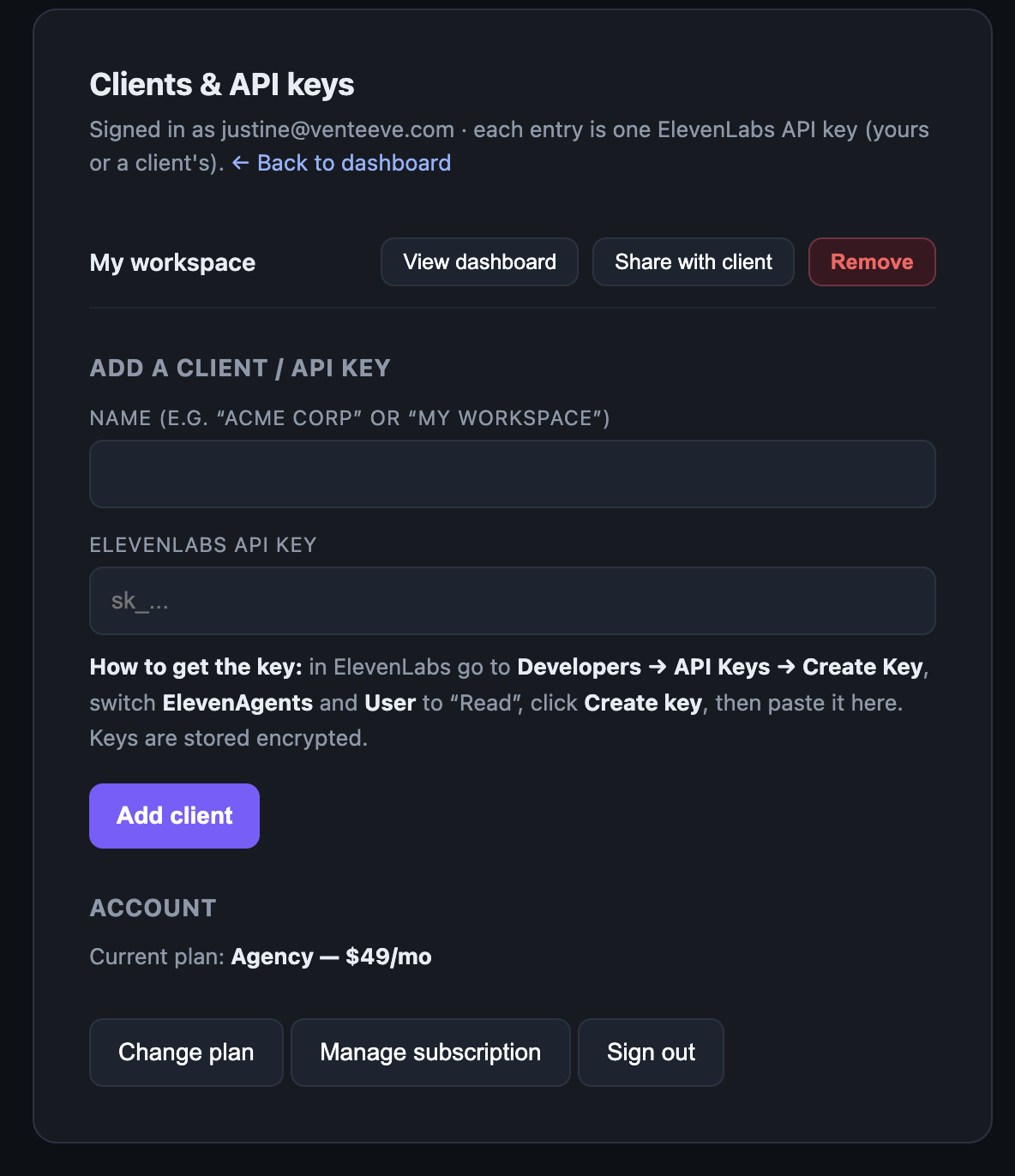
Every client is just an ElevenLabs API key — theirs or yours — stored encrypted. Add as many as you run. Each one gets its own dashboard.
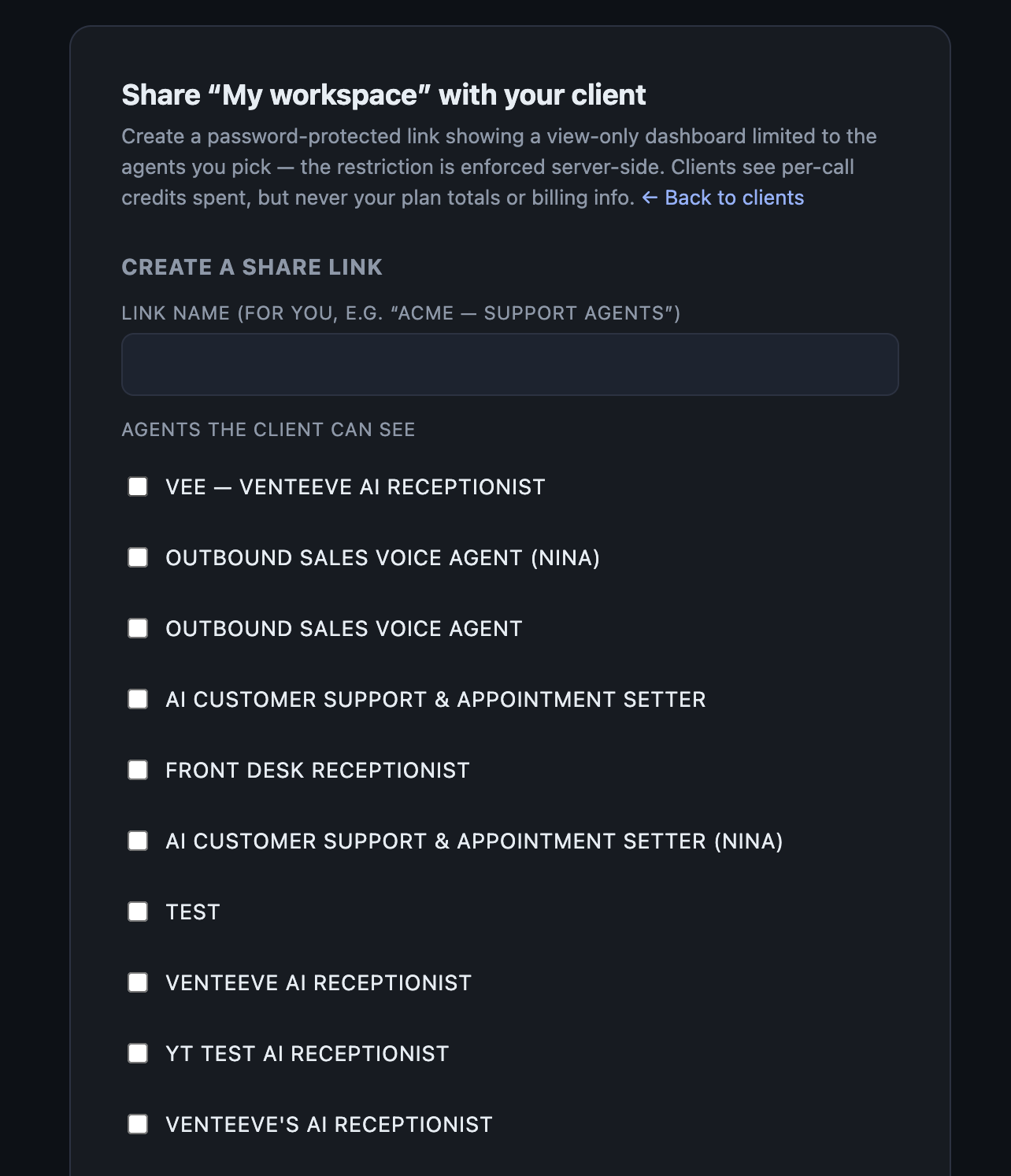
Then you share. You give the client their own login, you tick exactly which agents that client is allowed to see, and that restriction is enforced on the server — not hidden in the interface where a curious person with a browser console could go rummaging. Your client sees their agents, their calls, their per-call credit usage. They never see your plan totals, your billing, or anyone else's business.
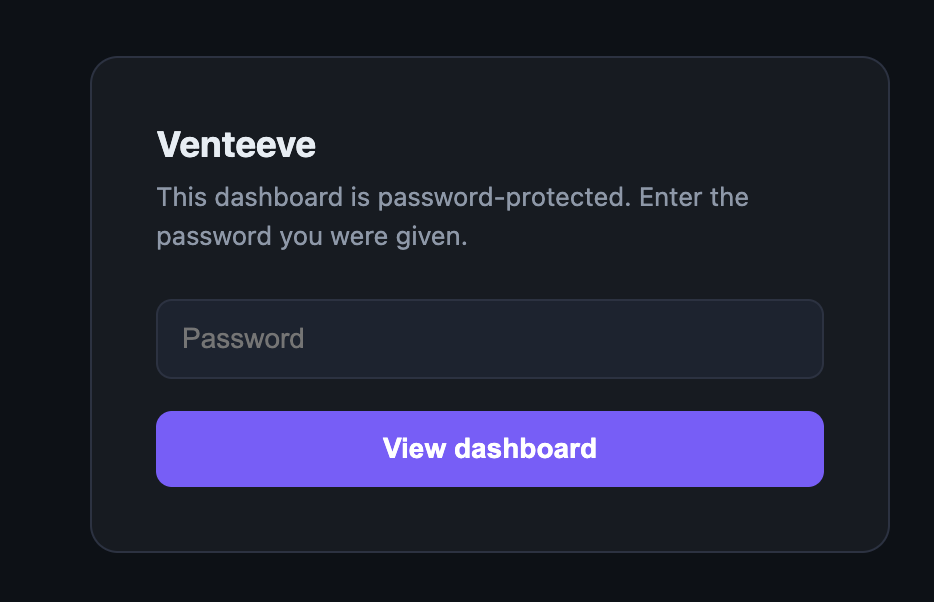
Which means the monthly report — the thing you dread, the thing that eats a Friday — stops being a deliverable you produce and becomes a link you sent once. The client checks it whenever they like. They feel closer to the work. You get your Friday back.
A Word From the Founder About the Price
Now the part that needs saying plainly, because it involves your money and a deadline.
When this was first written, the Agency plan was $49 a month. As promised, the price has now moved in line with the market: plans start at $97 a month, with Pro at $197 and Scale at $397, each including client logins on your own domain, your branding and unlimited AI Insights.
And the promise holds: everyone who subscribed at $49 keeps paying $49. Nobody was moved onto the new price. If you joined early, you are grandfathered where you started.
Justine explains it properly here, along with a walkthrough of the dashboard itself:
It is still well below what comparable agency tools charge, and every plan starts with a 14-day free trial, so you can check the maths on your own calls before paying anything.
What to Actually Do Next
If you're already running agents on ElevenLabs, this takes about two minutes to answer honestly. Connect a key, let it read your existing calls, and look at three things: your real success rate, your evaluation criteria panel, and the topics chart.
One of those three will tell you something you didn't know. It usually does. Maybe your success rate is better than you feared and you've been underselling yourself to a client. Maybe your agent has been quietly failing to book anyone for a fortnight. Maybe the thing everyone rings about isn't the thing you built the agent to handle.
That's the actual argument here, and it isn't really about dashboards. You cannot improve something you cannot see, and right now most people running AI agents are flying on vibes and a monthly credit bill. Go and look at what yours have been doing. The number is already there — somebody just has to open it.